
B1 Writing Exam Summary PDF
Download a concise B1 writing exam summary for Staatsexamen Nt2 Schrijven Programma I with the 100-minute plan, 12-task format, 2025 scoring, rubrics, sentence patterns, and example answers.
- Fact
- 100 minutes
- Fact
- 12 tasks
- Fact
- 25/47 points to pass
Overview
Schrijven Programma I is a long sit: 100 minutes, 12 tasks, 47 points spread across eight short sentence completions, one form, and three longer practical texts. The exam does not test essay flair — it tests whether you can match each answer to its situation, hit every required bullet, and keep your word order under control.
- Schrijven Programma I lasts 100 minutes and has 12 assignments.
- Tasks 1-8 are short sentence-completion tasks. They test whether your addition is understandable and grammatically correct.
- Task 9 is often a form or questionnaire. Full, clear answers are safer than one-word answers.
- Tasks 10-12 are longer practical writing tasks, often emails, reports, complaints, image descriptions, or table comparisons.
- The 2025 public exam had 47 points: adequacy 20, grammar 16, spelling 4, samenhang 3, and woordgebruik 4.
- If an answer does not match the task, grammar and other form points for that task can also disappear.
Task types
Zinstaken
Fill a short gap inside an email, website message, or note, usually with one sentence or sentence part. Max points: 2 per task. The classic slip is writing something grammatical that does not actually fit the message around it, or ignoring the grammar cue (want, zodat, daarom, om ... te) right before the gap. Read the lines on both sides of the gap first, then write an answer that follows the cue and keeps the message coherent.
- give a reason after want
- write a purpose after zodat
- start with Daarom and use inversion
- ask a question with om ... te
- Read the sentence before and after the gap.
- Make your answer fit the meaning of the whole message.
- Use the grammar pattern suggested by the words around the gap.
- Do not write extra information that changes the topic.
Formulier of vragenlijst
Fill in a form or a set of open questions — a course preference, workplace questionnaire, or request — where adequacy and clarity carry most of the marks. Max points: 7. The common mistake is reducing open questions to one-word answers, which often reads as incomplete to the scorer. Use full sentences on open questions, give a reason when the question asks waarom, and keep any invented details realistic.
- course preference form
- workplace questionnaire
- application or request form
- Answer every question.
- Use full sentences for open questions when possible.
- Give reasons when the question asks waarom.
- Keep invented details realistic and consistent.
Beeld- of tabeltaak
Turn a series of pictures, a process, or a comparison table into a connected text for a reader who will not see the source. Max points: 8. Most learners either describe only one or two images, or write phrases like 'op de foto' that make the text dependent on the source. Cover every image or relevant table cell, use sequence words (eerst, daarna, ten slotte), and write so the text stands alone.
- describe an outing from pictures
- compare internship options in a table
- explain a changed schedule
- Use every picture or every relevant table detail.
- Write in a logical order: first, next, later, finally.
- Explain your opinion or preference with concrete reasons.
- Do not write 'in the picture' if the reader will not see the picture.
Klacht, verzoek of advies
Write a longer email or letter to a company, manager, or organisation — to complain, request, propose, or advise — usually with several required bullets. Max points: 8. The classic loss is missing one required reason, solution, or contact step, or slipping into casual tone in a formal complaint. Open with why you write, work through every bullet in order, and close with what you expect from the reader.
- late delivery complaint
- proposal to keep an activity
- advice about a stage company
- Open with why you are writing.
- Answer every bullet from the assignment.
- Give at least the required number of reasons or solutions.
- End with what you expect from the reader.
Timing plan
| Time | What you do | Why |
|---|---|---|
| 0-5 min | Scan all 12 tasks | Notice which tasks are short gaps, which task is a form, and which longer tasks need images, a table, or a formal solution. |
| 5-25 min | Finish tasks 1-8 | Spend about two minutes per short task. Fit the meaning first, then quickly check word order. |
| 25-40 min | Complete the form task | Answer every question. For open questions, write one clear sentence with a reason or detail. |
| 40-86 min | Write tasks 10-12 | Use the bullets as a paragraph plan. Mention all required information before improving style. |
| 86-100 min | Check high-value points | Check missing bullets, formal or informal tone, verb position, dates, names, spelling, and whether the text works without images or tables. |
Rubric
Three rubrics by task type: short zinstaken score 2 across two criteria, the form scores 7 across four, and longer texts score 8 across five. Adequaatheid carries the most weight in every rubric, so hitting all required content points is what unlocks the form and grammar marks.
Zinstaken — 2 points each
| Score | What it means |
|---|---|
| Adequaatheid/begrijpelijkheid 0-1 | The completion is a clear and relevant answer to the situation. |
| Grammatica 0-1 | The completion is grammatically correct in the sentence. |
If adequaatheid/begrijpelijkheid scores 0, grammar automatically scores 0.
Formulier or questionnaire — 7 points
| Score | What it means |
|---|---|
| Adequaatheid 0-3 | All questions are answered and the information is understandable. |
| Grammatica 0-2 | Short answers and full sentences are grammatically clear. |
| Spelling 0-1 | Common words, names, dates, and details are spelled clearly. |
| Woordgebruik 0-1 | Vocabulary fits the form and the situation. |
A fully filled form with clear answers is the starting point for an acceptable score.
Longer writing tasks — 8 points
| Score | What it means |
|---|---|
| Adequaatheid 0-3 | The text answers all required content points and fits the reader and purpose. |
| Grammatica 0-2 | Sentence structure, verb position, and tense are clear enough for B1. |
| Spelling 0-1 | Spelling errors do not disturb understanding. |
| Samenhang 0-1 | The text has a logical order and uses linking words where useful. |
| Woordgebruik 0-1 | Vocabulary is practical, varied enough, and appropriate for the situation. |
Score 2 for adequacy is the practical baseline when all required content points are included.
Sentence patterns
Short completion tasks: Ik kan dan helaas niet, want ik heb een afspraak bij de gemeente. / Ik wil graag langskomen, zodat ik meer informatie over de opleiding kan krijgen. / Daarom kunnen we vandaag alleen beneden printen. / Wie heeft er zin om vrijdag samen te oefenen?
Form answers: Ik kies voor de cursus digitale administratie, omdat ik sneller met Excel wil werken. / Ik wil de cursus liever in de klas volgen, omdat ik dan direct vragen kan stellen. / Ik heb eerder een korte cursus gevolgd en ik vond die nuttig, maar te algemeen.
Images and timelines: Eerst kregen wij een rondleiding door het museum. / Daarna deden wij samen een kookworkshop. / De kookworkshop vond ik het leukst, omdat iedereen actief meedeed. / Volgend jaar wil ik graag naar Delft, omdat die stad mooi is en goed bereikbaar is.
Complaints and solutions: Op 12 maart heb ik bij u een eettafel besteld. / De tafel zou op 20 april geleverd worden, maar nu hoor ik dat de levering pas op 1 juni komt. / Ik vind dit vervelend, omdat ik al afspraken heb gemaakt voor de verhuizing. / Ik stel voor dat u mij tijdelijk een andere tafel leent of mij korting geeft. / Mijn voorkeur gaat uit naar korting, omdat ik zelf tijdelijk een oplossing kan regelen.
Table comparison: Administratiekantoor Dijk heeft mijn voorkeur, omdat de vergoeding het hoogst is en de werktijden goed passen. / Zorggroep Merel is minder geschikt, omdat de vergoeding lager is. / Gemeentehuis Linde is ook minder geschikt, omdat de reistijd veel langer is. / Wij kunnen het bedrijf bellen of samen een e-mail sturen naar de stagebegeleider.
Common mistakes
- Writing a sentence that is true but does not fit the words before and after the gap.
- Using omdat word order after want, or forgetting inversion after Daarom.
- Answering a form question with only one word when a full sentence would be clearer.
- Describing only one picture when the task asks you to use all pictures.
- Forgetting one required reason, solution, date, company name, or contact step.
- Writing 'the table says' instead of explaining the table information in full sentences.
- Using an informal tone in a formal complaint or request.
- Writing too much extra detail and creating avoidable grammar mistakes.
Sample answers
Opgave 1: Doel van een afspraak noemen
Sentence-completion task — give a clear purpose after zodat; verb moves to the end.
U wilt een afspraak maken met de studiecoördinator van uw opleiding. De e-mail begint zo:
Ik wil graag een afspraak maken, zodat ...
Maak de zin af. Geef een duidelijk doel. Gebruik de juiste woordvolgorde na zodat.
Self-check
- I give a clear purpose for the appointment.
- I put the verb at the end after zodat.
- My answer fits the message around it.
- I do not introduce a new topic.
Example answer
ik kan vragen welke boeken ik voor de opleiding moet kopen.
Opgave 2: Uitje met collega’s naar Leiden
Email task — describe a group outing using picture prompts; the text must be understandable without the pictures.
U werkt bij een organisatie. Vorige week was er een uitje naar Leiden met uw afdeling. Uw leidinggevende wil weten wat u van het uitje vond en welk idee u hebt voor volgend jaar.
De plaatjes komen niet bij uw e-mail. Uw tekst moet dus te begrijpen zijn zonder de plaatjes.
Beschrijf wat u en uw collega’s in Leiden hebben gedaan. Gebruik alle plaatjes. Schrijf welke activiteit u het leukst vond. Leg ook uit waarom. Schrijf naar welke stad u volgend jaar wilt gaan. Leg ook uit waarom.
Schrijf de e-mail aan uw leidinggevende.
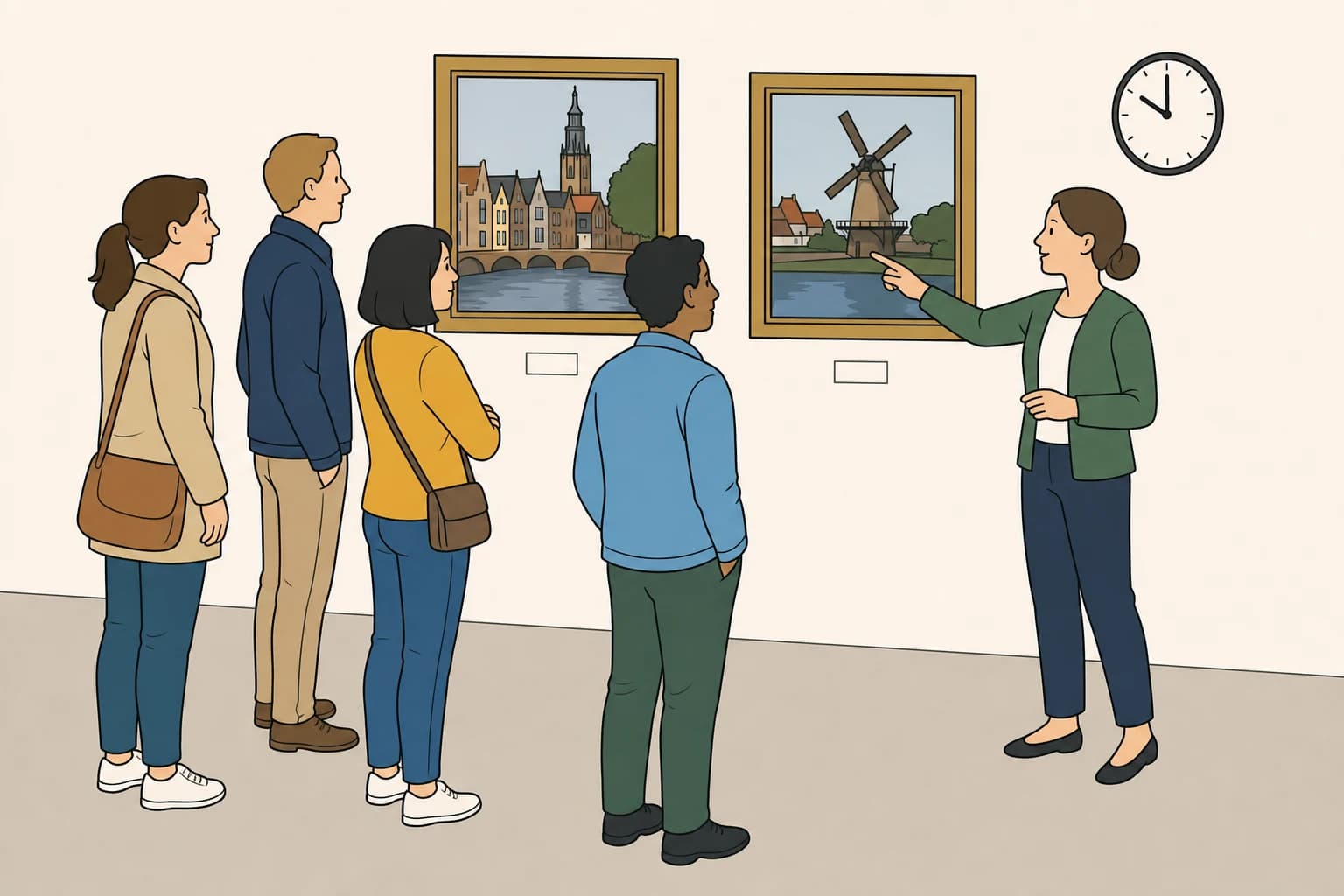
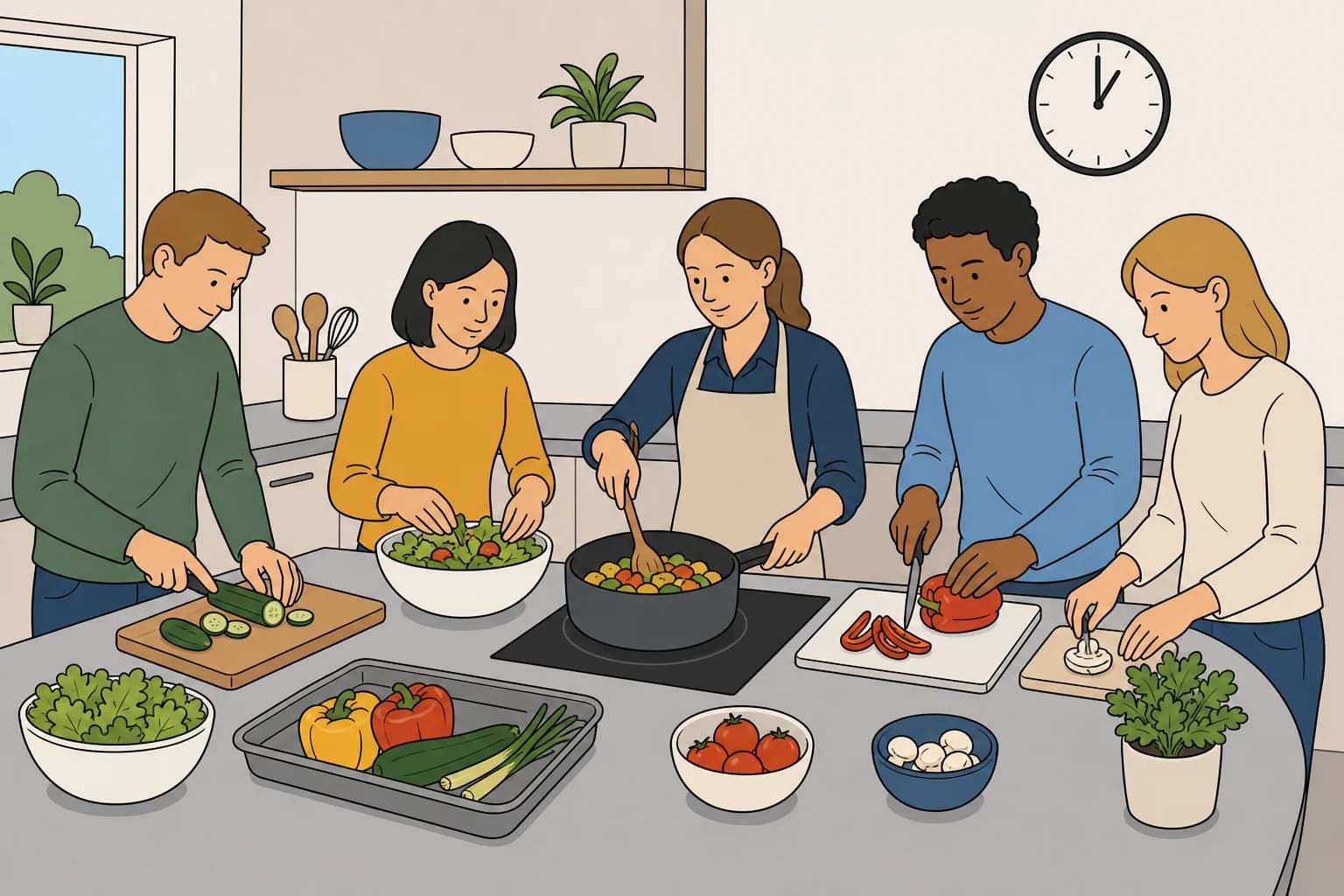
Self-check
- I describe both activities and my text works without the pictures.
- I name my favourite activity and give a reason.
- I suggest a city for next year and explain why.
- I use sequence words such as eerst and daarna.
Example answer
Beste meneer De Vries,
Vorige week zijn wij met de afdeling naar Leiden geweest. Eerst kregen wij een rondleiding in een klein museum. Daarna deden wij samen een kookworkshop en maakten wij lunch.
De kookworkshop vond ik het leukst, omdat iedereen actief meedeed en wij op een ontspannen manier met elkaar praatten. Volgend jaar wil ik graag naar Delft, omdat die stad mooi is en makkelijk met de trein te bereiken is.
Vriendelijke groet,
Opgave 3: Klacht over late levering
Complaint email task — describe an order, old and new delivery dates, two solutions, and a preference.
U hebt een nieuwe eettafel besteld bij een meubelwinkel. De tafel wordt zes weken later geleverd dan verwacht. U stuurt een e-mail naar de klantenservice.
Schrijf welke eettafel u hebt besteld en wanneer. Schrijf de oorspronkelijke en nieuwe leverdatum. Schrijf waarom u de late levering vervelend vindt. Doe een voorstel voor minimaal twee oplossingen. Schrijf welke oplossing uw voorkeur heeft en waarom. Schrijf wat u van het bedrijf verwacht.
Schrijf de e-mail aan de klantenservice.
Self-check
- I name the product and order date.
- I state both the original and new delivery dates.
- I explain why the delay is a problem for me.
- I give at least two solutions and state my preference.
Example answer
Geachte heer, mevrouw,
Op 12 maart heb ik bij u de eettafel Nora in licht eiken besteld. De tafel zou op 20 april geleverd worden, maar vandaag kreeg ik bericht dat de levering pas op 1 juni is.
Ik vind dit erg vervelend, omdat ik eind april verhuis en dan geen tafel heb. Ik stel voor dat u mij tijdelijk een andere tafel leent of dat u mij korting geeft op mijn bestelling. Mijn voorkeur gaat uit naar de tijdelijke tafel, omdat ik dan mijn huis normaal kan gebruiken.
Ik verwacht dat u deze week contact met mij opneemt met een oplossing.
Met vriendelijke groet,
Final checklist
- I answered every bullet in the assignment.
- My answer fits the sentence before and after the gap.
- I used complete sentences in form answers where useful.
- My longer text is understandable without the picture or table.
- I gave the required number of reasons, solutions, examples, or preferences.
- My tone matches the reader: formal, neutral, or informal.
- I checked word order after omdat, zodat, daarom, and want.
- I checked names, dates, times, amounts, and spelling before finishing.
Practise this skill in the app
Download the PDF, then jump into interactive practice for grading and feedback.