
Commencez par la liste de l’organisme destinataire
Avant de vous installer aux Pays-Bas, obtenez la liste des pièces demandées par l’organisme destinataire. Apportez les originaux, les copies officielles ou les fichiers qu’il accepte. Avec NetherlandsWorldwide (Site externe, s’ouvre dans un nouvel onglet), vérifiez si un acte étranger nécessite une apostille (certificat d’authentification) ou une autre procédure de legalisatie (authentification officielle). Vérifiez séparément les règles de traduction. Effectuez avant votre départ les démarches à faire dans le pays qui a délivré le document.
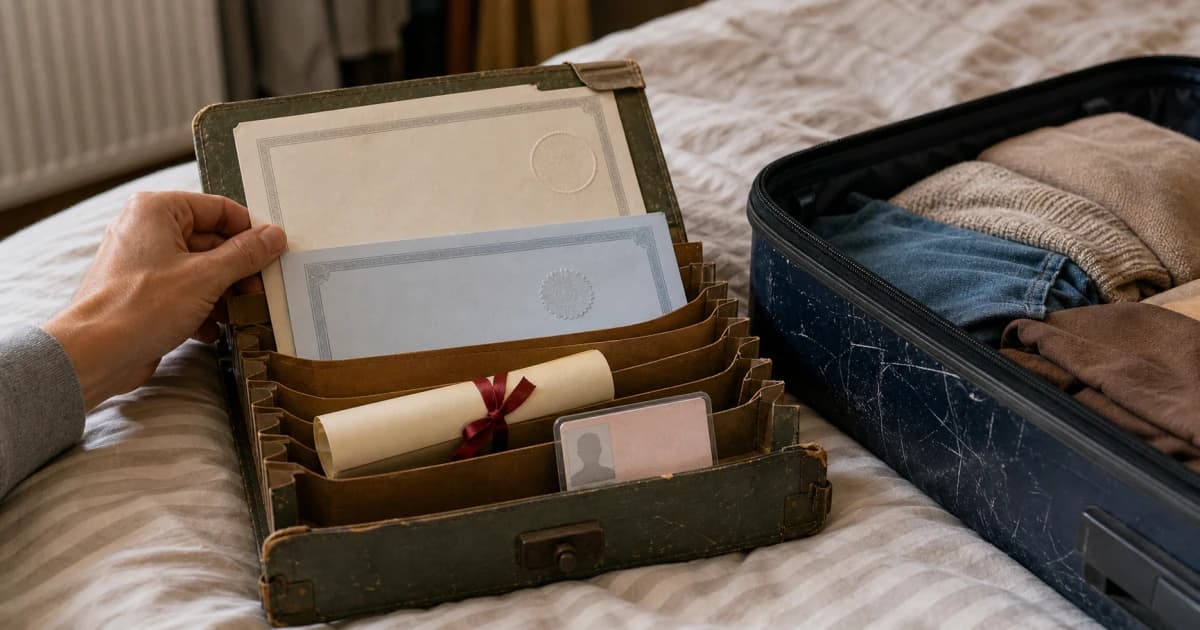
Les pièces à préparer dépendent de votre démarche. Votre gemeente (commune) indique celles à fournir pour l’inscription au BRP (Basisregistratie Personen, registre de la population). Les consignes varient d’une commune à l’autre : consultez la page de votre rendez-vous. Le formulaire de l’IND (Service de l’immigration et de la naturalisation) (Site externe, s’ouvre dans un nouvel onglet) précise les justificatifs de votre demande de séjour. Pour un diplôme, l’établissement, l’employeur ou l’autorité d’une profession décide des pièces nécessaires.
Repérez dans le tableau la démarche qui vous concerne. Préparez toutes les pièces de la liste de cet organisme. Vous n’avez pas à réunir tous les documents du tableau. Vérifiez la liste avant de commander un acte, de le faire légaliser ou de le faire traduire.
Vous pouvez faire défiler les tableaux larges horizontalement.
| Démarche | À consulter en premier | À préparer si l’organisme le demande |
|---|---|---|
| BRP et état civil | La gemeente où vous habiterez | Passeport, justificatif d’adresse et originaux ou actes officiels de sa liste de rendez-vous |
| Titre de séjour ou MVV (autorisation de séjour provisoire) | La page et le formulaire IND de votre démarche précise | Les justificatifs d’identité, de garant, de lien familial et les autres pièces indiquées. Faites légaliser et traduire les actes officiels étrangers lorsque c’est exigé. |
| Études | L’établissement néerlandais | Diplôme et relevé de notes. Beaucoup d’établissements obtiennent eux-mêmes un avis sur le niveau du diplôme. Demandez-leur avant de commander une évaluation. Consultez les consignes d’IDW (service d’évaluation internationale des diplômes) pour les études (Site externe, s’ouvre dans un nouvel onglet). |
| Travail | L’employeur ou l’autorité d’une profession réglementée (métier exigeant une reconnaissance officielle) | Diplôme, relevé de notes et justificatifs de reconnaissance professionnelle. Une équivalence de diplôme par IDW est généralement facultative pour un emploi hors profession réglementée. |
| Conduite | L’outil de RDW (organisme néerlandais chargé des véhicules et permis de conduire) (Site externe, s’ouvre dans un nouvel onglet) pour vérifier l’échange | Permis valable, traduction éventuelle et pièces pour l’échange auprès de votre gemeente. |
Demandez les bons actes d’état civil
Demandez uniquement les actes indiqués pour votre titre de séjour ou votre inscription à la gemeente. Il peut s’agir d’un acte de naissance, de mariage, de partenariat enregistré, de divorce, d’adoption ou de décès, ou d’une déclaration de célibat. Vérifiez le format attendu : acte original, extrait officiel ou copie certifiée officielle. Une simple photocopie ne suffit pas si l’organisme demande une copie officielle.
Si vous êtes né en France, vous pouvez demander gratuitement votre acte de naissance à la mairie du lieu de naissance. Choisissez la copie intégrale ou l’extrait selon ce que demande l’organisme néerlandais.
Si votre acte de naissance est marocain, demandez une copie intégrale. NetherlandsWorldwide précise que les autorités néerlandaises n’acceptent pas la fiche individuelle d’état civil, y compris lorsqu’elle est délivrée par une ambassade ou un consulat marocain aux Pays-Bas.
L’IND accepte normalement les actes constatant un fait fixe, comme une naissance ou un mariage, quelle que soit leur date de délivrance. En revanche, une déclaration de célibat doit dater de six mois au maximum. Une déclaration délivrée le 10 avril 2026 est donc trop ancienne le 11 octobre 2026. Pour la déposer à l’IND à cette date, demandez-en une nouvelle. Votre gemeente peut fixer ses propres consignes de dépôt.
Amsterdam (Site externe, s’ouvre dans un nouvel onglet) exige les originaux lorsque vous présentez des actes d’état civil étrangers. La page de La Haye sur la première inscription (Site externe, s’ouvre dans un nouvel onglet) demande d’apporter les actes que vous avez. S’il vous en manque, vous pouvez vous inscrire et les fournir à un rendez-vous ultérieur. Cette page concerne les personnes de nationalité hors UE (Union européenne), EEE (Espace économique européen) et Suisse. Vous devez justifier d’un séjour légal et prévoir de vivre à La Haye pendant au moins quatre mois. Vous ne devez pas avoir été inscrit auparavant aux Pays-Bas ni avoir de BSN (burgerservicenummer, numéro d’identification du citoyen).
IDW demande des copies numérisées en couleur de l’intégralité du document, avec toutes les informations lisibles. N’envoyez des originaux, des copies certifiées ou des documents légalisés que si IDW vous les demande. Suivez les consignes actuelles de l’organisme qui reçoit votre dossier.
Vérifiez la procédure de légalisation
La procédure dépend du pays ou du territoire qui a délivré le document, mais aussi de son type. Consultez sa page sur NetherlandsWorldwide pour choisir la ligne du tableau qui s’applique. Le fait qu’un pays utilise les apostilles ne suffit pas à déterminer la procédure.
Vous pouvez faire défiler les tableaux larges horizontalement.
| Type de document | Démarche à suivre |
|---|---|
| Acte public couvert par les règles de l’UE, délivré dans un autre pays de l’UE | Utilisez-le sans légalisation. Vérifiez que son type est bien couvert. Un formulaire multilingue peut aider pour la traduction ; joignez-le à l’acte. |
| Document couvert par l’Apostilleverdrag (convention internationale sur l’authentification des documents) | Demandez une apostille à l’autorité compétente du pays qui a délivré le document. Vérifiez que le pays, le territoire et le type de document sont couverts pour une utilisation aux Pays-Bas. |
| Document nécessitant une légalisation complète | Suivez les étapes de la page du pays dans l’ordre. Elles peuvent faire intervenir l’autorité qui a délivré l’acte, un ministère et une ambassade ou un consulat néerlandais. |
| Document d’Aruba, Curaçao, Sint Maarten, Bonaire, Saba ou Sint Eustatius | Vous pouvez l’utiliser ailleurs dans le Royaume des Pays-Bas sans légalisation. |
Une apostille peut être un cachet, un autocollant ou un certificat séparé. Elle authentifie la signature et l’autorité qui a délivré le document. Une légalisation complète fait intervenir plusieurs autorités. La légalisation vérifie la signature officielle, le sceau ou le cachet. L’organisme destinataire peut encore vérifier les faits indiqués dans le document. La traduction reste une démarche distincte.
Suivez les instructions officielles pour le pays qui a délivré le document. Une liste publiée sur un blog ne suffit pas. Par exemple, les Pays-Bas ne reconnaissent pas les apostilles du Bangladesh ou du Pakistan. Si vous avez la nationalité néerlandaise, le Consulair Dienstencentrum (CDC, Centre de services consulaires) (Site externe, s’ouvre dans un nouvel onglet) peut parfois vous aider pour un pays de sa liste. Vérifiez cette possibilité avant de payer une agence privée.
Vérifiez si une traduction est nécessaire et quand la faire
Pour une demande à l’IND, un document rédigé en français, néerlandais, anglais ou allemand n’a pas besoin de traduction. Un document dans une autre langue doit être traduit vers l’une de ces quatre langues. Si vous faites traduire le document aux Pays-Bas, choisissez un beëdigd vertaler (traducteur assermenté) ayant prêté serment devant un tribunal néerlandais.
Vous pouvez aussi faire traduire le document à l’étranger. Dans ce cas, l’original et la traduction doivent généralement être légalisés. Vérifiez les règles du pays qui a délivré l’acte : elles précisent le traducteur à choisir et l’ordre des démarches. L’apostille de l’original couvre cet original ; vérifiez séparément les exigences pour la traduction. Présentez toujours le document dans sa langue d’origine avec sa traduction.
Les consignes de NetherlandsWorldwide pour l’Inde (Site externe, s’ouvre dans un nouvel onglet) donnent un exemple. Un document en hindi traduit en Inde doit avoir une traduction assermentée, et les deux documents doivent porter une apostille. Si vous choisissez de le faire traduire aux Pays-Bas, faites d’abord apostiller l’original en Inde. Faites-le ensuite traduire par un traducteur assermenté aux Pays-Bas. Cette traduction n’a pas besoin de légalisation.
Préparez les justificatifs de diplôme adaptés à votre projet
Une diplomawaardering (équivalence de diplôme) compare un diplôme étranger à un niveau d’études néerlandais. Elle donne un avis, sans valeur juridiquement contraignante. L’établissement décide toujours de votre admission. Pour une profession réglementée, vous devez suivre sa procédure de reconnaissance. La légalisation est une vérification distincte.
Avant de commander une évaluation, repérez la ligne correspondant à votre projet. Une équivalence de diplôme par IDW est souvent facultative.
Vous pouvez faire défiler les tableaux larges horizontalement.
| Votre projet | Première démarche |
|---|---|
| Entrer dans une formation néerlandaise | Contactez d’abord l’établissement. La plupart reçoivent gratuitement un avis sur le niveau du diplôme et décident eux-mêmes de l’admission. |
| Postuler à un emploi hors profession réglementée | Demandez à l’employeur. L’évaluation est généralement facultative, mais il peut l’exiger. |
| Exercer une profession réglementée | Contactez d’abord l’autorité de cette profession. L’équivalence de diplôme seule ne vaut pas reconnaissance professionnelle. |
| Suivre la voie inburgering (intégration civique), naturalisation ou séjour permanent | Consultez les conditions d’évaluation gratuite d’IDW (Site externe, s’ouvre dans un nouvel onglet). Les personnes admissibles peuvent obtenir une évaluation gratuite ; les pièces à fournir diffèrent. |
Réunissez les documents et traductions pour IDW
Suivez la liste des documents demandés par IDW (Site externe, s’ouvre dans un nouvel onglet) pour réunir votre diplôme et le relevé complet des notes ou le supplément au diplôme. Si le nom sur votre pièce d’identité diffère de celui sur le diplôme, joignez un justificatif du changement de nom. Numérisez chaque page en couleur, de façon lisible. IDW évalue un diplôme par demande. Le service peut demander des justificatifs supplémentaires selon le pays ou vos études antérieures.
Pour une demande IDW liée au travail ou aux études, déposez une pièce d’identité valable encore au moins trois mois. Pour une évaluation gratuite dans le cadre de l’intégration, déposez les deux faces de votre titre de séjour, valable encore au moins trois mois, et la lettre d’intégration demandée. Pour une évaluation gratuite liée à la naturalisation ou au séjour permanent, fournissez un document officiel portant votre BSN.
IDW n’exige pas de traduction certifiée pour les documents en français, néerlandais, anglais, allemand ou afrikaans. Pour les autres langues, fournissez une traduction assermentée, sauf si votre établissement vous a donné une version en anglais. Déposez cette version anglaise avec le document dans sa langue d’origine. Si vous demandez une évaluation gratuite dans le cadre de l’intégration, de la naturalisation ou du séjour permanent, vous n’avez pas besoin de traduction certifiée.
L’évaluation gratuite reste soumise à des conditions. Si vous avez déjà un inburgeringsdiploma (diplôme d’intégration), IDW vous demande de passer par une démarche payante. L’évaluation d’un diplôme étranger et la dispense d’examens d’intégration sont deux décisions distinctes. Pour la dispense d’examens, consultez le guide des dispenses d’inburgering.
Anticipez les délais d’IDW et les documents manquants
Si vous avez besoin d’une équivalence de diplôme par IDW, faites la demande en ligne. En octobre 2026, IDW annonce environ six semaines ouvrables pour le premier contrôle. L’évaluation prend ensuite environ huit semaines ouvrables, une fois les documents suffisants. Des fichiers manquants ou peu lisibles peuvent entraîner une nouvelle attente d’environ six semaines ouvrables pour le premier contrôle. IDW peut aussi demander des renseignements pendant l’évaluation.
Si vous êtes ou avez été réfugié, demander des documents scolaires manquants peut vous mettre en danger. Vous pouvez quand même déposer une demande dans cette situation. Expliquez-la et fournissez les pièces que vous avez. IDW détermine s’il peut évaluer votre diplôme. Si vous n’avez aucun document scolaire, IDW peut proposer une Indicatie Onderwijsniveau (estimation du niveau d’études) à partir de vos renseignements. Cette estimation diffère d’une équivalence de diplôme, car elle ne s’appuie sur aucun document scolaire.
Vérifiez votre permis de conduire séparément
Utilisez l’outil RDW pour vérifier si votre permis peut être échangé. Un permis de l’UE ou de l’AELE (Association européenne de libre-échange) est échangeable si vous remplissez toutes les conditions de RDW. Un permis expiré de l’UE ou de l’AELE peut aussi être échangé si ces conditions sont remplies. La durée pendant laquelle vous pouvez conduire dépend de la date de délivrance du permis, de ses catégories et de sa validité.
Un permis valable délivré hors UE ou AELE permet normalement de conduire pendant les 185 premiers jours après votre installation. Ensuite, vous avez besoin d’un permis néerlandais pour conduire, même si votre demande d’échange est encore en cours. Une règle distincte s’applique aux permis ukrainiens des personnes couvertes par la Richtlijn Tijdelijke Bescherming (directive sur la protection temporaire). Consultez les règles de conduite de RDW avec un permis étranger (Site externe, s’ouvre dans un nouvel onglet) pour votre situation.
L’échange est limité aux pays, territoires et exceptions indiqués par RDW. Certaines situations relevant de l’expatregeling (régime fiscal des expatriés) permettent aussi un échange. Si votre permis ne peut pas être échangé, vous devez passer les examens théorique et pratique du CBR (organisme néerlandais des examens de conduite) (Site externe, s’ouvre dans un nouvel onglet). Déposez la demande d’échange auprès de votre gemeente après votre inscription au BRP. Le guide de l’échange d’un permis étranger présente les démarches possibles.
Pour une demande d’échange, RDW exige une traduction si votre permis utilise des caractères non utilisés aux Pays-Bas, comme les caractères japonais ou grecs. Faites appel à un traducteur assermenté, une ambassade ou un consulat. Pour un permis délivré hors UE ou AELE, RDW conseille un permis international si les catégories portent des désignations différentes de A, B, C, D ou E. Obtenez-le dans le pays qui a délivré le permis avant votre départ.
Emportez les originaux et des fichiers de sauvegarde lisibles
Vérifiez ces points pour chaque document demandé. Les pièces scolaires ne vous concernent que si vous devez justifier votre formation.
- Gardez chaque original ou copie officielle avec les pages d’apostille ou de légalisation et la traduction assermentée, si elles sont nécessaires.
- Numérisez en couleur chaque page, cachet, autocollant et traduction, de façon lisible. Gardez aussi l’original lorsque l’organisme l’exige.
- Emportez la liste précise de l’IND, de la gemeente, de l’établissement ou de l’employeur que vous avez suivie, avec son numéro de version ou votre date de consultation.
- Apportez les diplômes demandés, les relevés complets de notes et les justificatifs reliant les différents noms figurant sur votre passeport et vos actes.
- Vérifiez les dates d’expiration du passeport et du permis de conduire. Vérifiez la date de délivrance exigée pour toute déclaration dont la durée de validité est limitée.
- Gardez les documents irremplaçables en sécurité et accessibles pendant le voyage. Si vous devez les envoyer, utilisez un courrier suivi.
Résolvez les problèmes de documents avant de payer
Si un document manque ou ne peut pas être utilisé, contactez l’organisme qui le demande. Le tableau vous aide à vérifier ce qu’il peut accepter avant de payer un remplacement.
Vous pouvez faire défiler les tableaux larges horizontalement.
| Problème | Que faire ? |
|---|---|
| Vous n’avez qu’un fichier numérisé, mais l’organisme exige un original | Demandez quel remplacement officiel ou quelle autre solution il peut accepter. Un fichier numérisé seul ne répond pas à l’exigence d’un original. |
| La légalisation est impossible à cause d’une guerre, d’un conflit ou de l’absence d’autorités | Demandez à l’organisme destinataire comment il vérifiera et examinera le document. Si la légalisation est impossible, cet organisme décide de ce qu’il peut accepter. |
| Votre diplôme et votre pièce d’identité portent des noms différents | Pour IDW, déposez un justificatif du changement de nom, par exemple un acte de mariage. |
Utilisez les documents après votre arrivée
Prenez le rendez-vous adapté à votre situation auprès de la gemeente. Apportez toutes les pièces de sa liste. Si votre installation exige un MVV ou un titre de séjour, suivez la liste de justificatifs propre à cette démarche. Le guide du regroupement familial et la présentation des titres de séjour vous aident à la choisir.
Pour l’ordre des démarches — inscription, BSN, DigiD (identifiant numérique pour les services publics) (Site externe, s’ouvre dans un nouvel onglet) et assurance — consultez ces guides :
- Auteur
- Par Inburgering.org team
- Relecteur
- Relu par Kirill Svavolia
Sources officielles
- NetherlandsWorldwide: Legalisation of foreign documents for use in the Netherlands (Site externe, s’ouvre dans un nouvel onglet) - L’outil par pays et type de document ; la légalisation se fait généralement dans le pays où le document a été établi.
- NetherlandsWorldwide: What is an apostille? (Site externe, s’ouvre dans un nouvel onglet) - Ce que l’apostille authentifie, ses différents formats et la reconnaissance des apostilles électroniques étrangères aux Pays-Bas.
- NetherlandsWorldwide: Do I need an apostille? (Site externe, s’ouvre dans un nouvel onglet) - Les règles selon le document et son pays d’origine, dont les dispenses de légalisation pour de nombreux actes publics de l’UE.
- IND: Translation and legalisation of documents (Site externe, s’ouvre dans un nouvel onglet) - Les langues acceptées par l’IND, les traductions assermentées aux Pays-Bas ou à l’étranger, les règles de légalisation et la limite de six mois pour une déclaration de célibat.
- NetherlandsWorldwide: Countries where the Consular Service Centre can assist with legalisation (Site externe, s’ouvre dans un nouvel onglet) - Les pays où le Centre de services consulaires peut aider les personnes de nationalité néerlandaise à obtenir ou légaliser un document étranger.
- Nuffic (organisme néerlandais pour la coopération internationale dans l’éducation) : Applying for a credential evaluation (Site externe, s’ouvre dans un nouvel onglet) - L’équivalence de diplôme donne un avis ; la page indique où la demander et pourquoi l’établissement ou l’employeur prend sa propre décision.
- IDW: Longer processing times (Site externe, s’ouvre dans un nouvel onglet) - Les délais d’octobre 2026 : environ six semaines ouvrables pour le premier contrôle, puis huit pour l’évaluation ; de nouveaux fichiers relancent l’attente du premier contrôle.
- RDW: Exchanging a foreign driving licence (Site externe, s’ouvre dans un nouvel onglet) - Les conditions d’échange, les pays concernés, l’inscription au BRP, la demande auprès de la commune et les autres démarches possibles lorsque l’échange n’est pas autorisé.
- NetherlandsWorldwide: What is document legalisation? (Site externe, s’ouvre dans un nouvel onglet) - Les étapes auprès de plusieurs autorités, les limites de l’authentification et les solutions lorsque la légalisation est impossible.
- NetherlandsWorldwide: In which countries are apostilles valid? (Site externe, s’ouvre dans un nouvel onglet) - Les pays et territoires concernés, dont les exceptions néerlandaises pour les apostilles du Bangladesh et du Pakistan.
- European e-Justice Portal: Public documents (Site externe, s’ouvre dans un nouvel onglet) - Les actes publics de l’UE concernés et les formulaires multilingues à joindre à l’acte comme aide à la traduction.
- NetherlandsWorldwide: Legalisation of documents from India (Site externe, s’ouvre dans un nouvel onglet) - L’exemple d’un document en hindi traduit en Inde : l’original et la traduction doivent chacun porter une apostille.
- Amsterdam: Foreign documents (Site externe, s’ouvre dans un nouvel onglet) - La règle d’Amsterdam : présenter les originaux des actes d’état civil étrangers.
- The Hague: First registration with a residence permit (Site externe, s’ouvre dans un nouvel onglet) - La première inscription pour les personnes de nationalité hors UE, EEE et Suisse ; apporter les actes disponibles ou les fournir à un rendez-vous ultérieur si vous ne les avez pas encore.
- IDW: To work (Site externe, s’ouvre dans un nouvel onglet) - La demande en ligne, un diplôme par demande et la différence entre évaluation facultative et reconnaissance d’une profession réglementée.
- IDW: To study (Site externe, s’ouvre dans un nouvel onglet) - Les établissements décident de l’admission ; la plupart reçoivent gratuitement un avis sur le niveau du diplôme.
- IDW: Required documents (Site externe, s’ouvre dans un nouvel onglet) - Les copies numérisées en couleur, les justificatifs de formation et de changement de nom, ainsi que les règles de traduction et l’exception pour les voies gratuites.
- IDW : Inburgering (Site externe, s’ouvre dans un nouvel onglet) - Les conditions d’évaluation gratuite, l’exclusion avec un diplôme d’intégration et les possibilités pour les réfugiés actuels ou anciens ayant des documents manquants.
- RDW: Driving with a foreign driving licence (Site externe, s’ouvre dans un nouvel onglet) - Les durées de conduite autorisées, la limite de 185 jours, le permis international et la règle propre à la protection temporaire des personnes venant d’Ukraine.
- Rijksoverheid (gouvernement néerlandais) : inscription au BRP (Site externe, s’ouvre dans un nouvel onglet) - L’inscription auprès de la commune et l’attribution du numéro BSN après l’inscription.
- DUO (service néerlandais de l’éducation) : dispenses grâce à un diplôme (Site externe, s’ouvre dans un nouvel onglet) - Les dispenses d’examens dépendent du diplôme et de la décision de DUO, indépendamment d’une équivalence de diplôme étranger.
- IDW : Inburgering, version néerlandaise (Site externe, s’ouvre dans un nouvel onglet) - L’Indicatie Onderwijsniveau, une estimation du niveau d’études distincte d’une équivalence de diplôme pour les personnes réfugiées sans documents scolaires.
- RDW : échange d’un permis de conduire étranger, version néerlandaise (Site externe, s’ouvre dans un nouvel onglet) - Les pièces à fournir pour l’échange, dont la traduction des permis écrits avec des caractères non utilisés aux Pays-Bas.
- RDW : conduire avec un permis étranger, version néerlandaise (Site externe, s’ouvre dans un nouvel onglet) - Le conseil d’obtenir un permis international pour un permis hors UE ou AELE dont les catégories portent des désignations différentes.
- La Haye : première inscription avec un titre de séjour, version néerlandaise (Site externe, s’ouvre dans un nouvel onglet) - Apporter les actes d’état civil disponibles ; s’ils manquent, les fournir à un rendez-vous ultérieur.
- NederlandWereldwijd (service d’information des Pays-Bas) : Apostilleverdrag (convention internationale sur l’authentification des documents) (Site externe, s’ouvre dans un nouvel onglet) - Le nom néerlandais de la convention et les pays où les apostilles sont valables.
- IND : traduction et légalisation des documents, version néerlandaise (Site externe, s’ouvre dans un nouvel onglet) - La limite de six mois, les langues acceptées, les traducteurs assermentés par un tribunal néerlandais et les procédures de traduction à l’étranger propres au pays qui a délivré le document.
- NederlandWereldwijd : légalisation des documents, version néerlandaise (Site externe, s’ouvre dans un nouvel onglet) - La légalisation ne confirme pas les faits indiqués dans un document ; l’organisme destinataire peut les vérifier séparément.
- Service Public : Acte de naissance : demande de copie intégrale ou d’extrait (Site externe, s’ouvre dans un nouvel onglet) - Pour une naissance en France, la demande officielle est gratuite et peut se faire auprès de la mairie du lieu de naissance.
- Watiqa : À propos (Site externe, s’ouvre dans un nouvel onglet) - Le portail public marocain permet de demander un extrait ou une copie intégrale d’acte de naissance.
- NetherlandsWorldwide: Legalisation of documents from Morocco for use in the Netherlands (Site externe, s’ouvre dans un nouvel onglet) - Les autorités néerlandaises demandent une copie intégrale et n’acceptent pas la fiche individuelle d’état civil marocaine.