
Check mobile activation and home internet availability
If you need mobile service while you compare subscriptions, consider a prepaid SIM (mobile network card). Check activation rules and phone compatibility before paying. For home internet, check which providers serve your exact address. Compare the full cost and contract length, then confirm the activation date and any installation appointment.
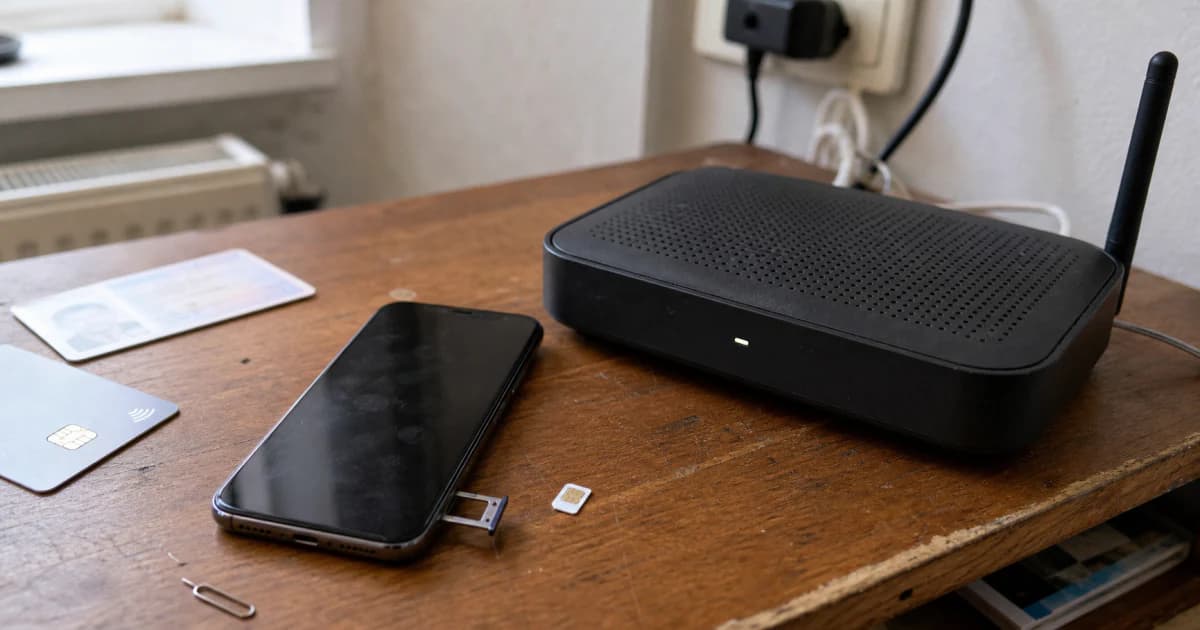
This guide covers personal mobile and home internet contracts for newcomers living in the Netherlands.
Choose how to pay for mobile service
You can buy prepaid credit, choose sim-only (a subscription without a phone), or take a subscription with a phone. Prepaid means you pay for calls and data in advance. With sim-only, you use a phone you already own. Paying for a new phone in instalments means borrowing the amount left after any upfront payment.
In 2026, device loans above €250 are registered with BKR (Bureau Kredietregistratie, the Dutch credit register) (External site, opens in a new tab). If you already own a phone, compare prepaid and sim-only before borrowing for a new one.
You can scroll wide tables sideways.
| Option | Check before ordering | How you pay |
|---|---|---|
| Prepaid | Activation, identity checks, rates and credit expiry | Buy credit in advance |
| Sim-only | Coverage, data, total cost, contract length and payment method | Pay for service; you provide the phone |
| Phone with subscription | Service costs and device-loan terms | Pay for service and repay the phone loan |
Prepaid can help while you compare subscriptions or wait for documents. Check the seller’s identity and activation rules. Before paying, check whether the SIM works in your phone, how to add credit, when credit expires and whether digital SIM activation is available.
Check device credit
When you pay for a phone in instalments with toestelkrediet (device credit), the provider must check whether you can afford the monthly costs. The provider must explain the loan terms and interest. It must also show the phone costs separately from the service costs. Rijksoverheid (Dutch central government) (External site, opens in a new tab) explains how an upfront payment can reduce the loan to less than €250. At exactly €250, check the provider’s credit terms: Odido’s terms require registration (External site, opens in a new tab).
Example for 2026: a phone costs €600. You pay €400 upfront and borrow the remaining €200. That loan is below the €250 registration threshold. You still pay the mobile service charges and repay the €200.
BKR registers device loans above the threshold even when you pay on time. Lenders can take the loan into account when you apply for another loan, including a mortgage.
The phone loan and mobile service are separate agreements. Ending or changing your service does not always make the remaining phone balance due immediately. Before cancelling or changing your service, check the loan’s own terms to see whether repayments continue or you must pay the balance. Ask for a written repayment schedule showing the remaining balance and payment dates.
Check mobile coverage and phone features
Check coverage where you will use your phone, including your usual routes and indoors at home and work. Building materials and your position indoors can affect reception. Brands using the same network can offer different speeds and features. Check the plan’s 5G (fifth-generation mobile network) access, calling features and any limits on data use or speed. If possible, test reception before taking a long contract. ACM ConsuWijzer (consumer advice from Autoriteit Consument & Markt, the Dutch Authority for Consumers and Markets) (External site, opens in a new tab) explains what to compare.
Rijksinspectie Digitale Infrastructuur (RDI, Dutch Authority for Digital Infrastructure) (External site, opens in a new tab) lists three mobile networks in the Netherlands: KPN, Odido and VodafoneZiggo. Other brands can be MVNOs (mobile virtual network operators) that use one of these networks. The ACM Telecom Monitor for the fourth quarter of 2025 (External site, opens in a new tab) lists the operators and their market shares.
An eSIM (digital SIM) is installed in a compatible phone. Check whether your provider and phone support it. Check how to activate it and transfer your number. To keep a foreign SIM active alongside a Dutch line, check dual-SIM (two-line) support and whether the phone is unlocked for other providers. For an iPhone, Apple’s dual-SIM guide (External site, opens in a new tab) explains the compatible models and provider requirements.
Check the documents and payment method
Providers set identity and fraud checks for each product and way of ordering, such as a website, shop or phone order. Ask the provider about all three checks:
- Identity: which passport, identity card or residence document does the website, shop or courier accept?
- Payment: which payment methods and IBANs (international bank account numbers) can you use?
- Credit: which affordability and credit checks apply if you pay for a phone in instalments?
A company that offers euro transfers or direct debits must accept an eligible payment-account IBAN from the EU (European Union) or EEA (European Economic Area). You do not need a Dutch IBAN for these payments. If its online form accepts only Dutch IBANs, the company can offer another way to enter a foreign IBAN. It must clearly explain that option on the form.
If a company refuses your IBAN because of its country code, see The provider asks for a Dutch IBAN. For more on account requirements, see Opening a Dutch bank account.
Keep your number and check roaming costs
Nummerbehoud (keeping your phone number) is free. Ask your new provider to transfer your Dutch mobile number. Your old provider may not refuse or charge for the transfer. Prepaid numbers qualify too. You can request a transfer until one month after the old contract ends. Apply early enough for the providers to process it. The ACM ConsuWijzer number-transfer guide (External site, opens in a new tab) explains the procedure.
Transferring your number before the fixed term ends can leave you with charges under the old contract. For a fixed telephone number, you can keep it only when you stay within the same area-code region.
Roam like at home (using your domestic mobile plan abroad) covers the EU, Iceland, Liechtenstein, Norway, Moldova and Ukraine. Your roaming data allowance can be smaller than your domestic allowance. Capped extra charges can apply if you exceed that allowance or use the SIM mainly abroad. Check your plan’s conditions in Your Europe’s roaming guide (External site, opens in a new tab).
Satellite networks on ships or aircraft fall outside these roaming rules and can cost more. Turn off roaming or use flight mode to avoid connecting to them.
Check home internet at your exact address
Home internet can use glasvezel (fibre), kabel (cable) or DSL (internet over a copper telephone line). Available connections and providers depend on your address. Enter your postcode and house number on provider websites or comparison sites. The ACM ConsuWijzer fixed-internet guide (External site, opens in a new tab) explains why the options vary.
Compare offers using the same details: speed for your household, price after discounts, one-off charges and total cost over the fixed term. Also compare contract length, equipment, delivery, activation date and any technician fee or appointment. Choose a speed that meets your household’s needs before paying for a faster plan.
Order and switch with confirmed dates
Follow these steps for a home internet order:
- Check which connections and providers serve your postcode and house number.
- Compare the full contract cost and installation requirements.
- Ask the chosen provider to confirm the activation date.
- If you are switching, confirm who will cancel the old contract and on which date.
- Save the order confirmation.
- Connect the modem or attend the agreed installation appointment.
Installation depends on the provider and address. The provider may need to activate the line or send a monteur (technician). Ask what happens if the promised start date is missed.
For an online or phone order, bedenktijd (cooling-off period) lets you cancel without giving a reason. For service alone, the period ends 14 days after the day you agree to the contract. For a combined phone-and-service order, it ends 14 days after the day you receive the phone. An ordinary shop purchase has no statutory cooling-off period. The ACM ConsuWijzer cooling-off guide (External site, opens in a new tab) explains the rules.
If you agreed in advance to early activation and to paying for service used, you pay for that part when you cancel. Without permission to start early, you can claim a full refund. If the deadline falls on a weekend or public holiday, it moves to the next working day.
When switching home internet, check whether the provider offers overstapservice (a switching service). Confirm who cancels the old contract. If the new provider promised to cancel it but failed, cancel the old service as soon as you find out. Keep both confirmations. You still owe the old provider’s bill, but the new provider must reimburse the extra costs caused by its failure. The ACM ConsuWijzer switching-problems guide (External site, opens in a new tab) explains the remedy.
Check when you can cancel your contract
After the fixed term, you can cancel free with at most one month’s notice. Read the contract summary before accepting. The ACM ConsuWijzer cancellation guide (External site, opens in a new tab) explains these term and notice rules in 2026.
You can scroll wide tables sideways.
| Rule | What it means |
|---|---|
| Maximum fixed term | At most 2 years; the provider needs a good reason for a 2-year term, such as a discount |
| After the fixed term | Cancel free at any time with at most 1 month’s notice, starting on the day you cancel |
| End-of-term notice | The provider must contact you at least 1 month before the fixed term ends |
| Disadvantageous change | Usually cancel free within 1 month after notification; exceptions apply below |
For a disadvantageous price or terms change, the provider must normally inform you one month in advance. You can usually cancel without extra costs within one month after notification. If one service in a bundle changes to your disadvantage, you can cancel the whole bundle. The ACM ConsuWijzer terms-change guide (External site, opens in a new tab) explains the right and these two exceptions:
- A change required by a new law or government rule gives no free cancellation right for that reason.
- An inflation adjustment gives no free cancellation right if the terms clearly explain the adjustment, including how often and when it happens.
Cancelling during a fixed term can involve charges stated in the contract. Ask for a written calculation with separate amounts for the service, unpaid phone balance and equipment return. Check the phone-loan agreement separately: repayments may continue, or you may have to pay the remaining balance. Ask when each amount is due.
Solve contract and connection problems in writing
Ask the provider to explain the problem and proposed solution in writing. Keep the order, contract, bills and messages so you can support a complaint.
The provider asks for a Dutch IBAN
Ask whether you can enter an EU or EEA euro payment-account IBAN manually or order through another route. If the company refuses it because of the country code, complain in writing and keep the refusal and your complaint. If the company gives no suitable solution or does not reply, report it to De Nederlandsche Bank (DNB, the Dutch central bank) (External site, opens in a new tab).
The provider rejects your documents
Ask which requirement applies to your product and way of ordering. For example, Odido’s ordering page (External site, opens in a new tab) says a foreign passport or non-Dutch European identity card permits sim-only, but not a subscription with a phone.
In October 2026, Odido accepts a foreign payment-account IBAN only in its shops and only for sim-only. For that order, it requires all three documents below:
- Your foreign bank card.
- A valid identity document.
- A BRP-uittreksel (extract from the municipal Personal Records Database).
The extract must be no older than one week and show at least six months of registration in the Netherlands.
If the extract lacks your registration date, Odido asks for an extra statement from your gemeente (municipality). You pay for the extract yourself. Odido rejects non-resident extracts. These are Odido’s requirements. If you cannot meet them, compare another way of ordering, prepaid or another provider. The BSN (citizen service number) and municipal registration guide explains the wider registration process.
Your address has no active home connection
A 4G (fourth-generation mobile network) or 5G router can provide a temporary connection. Check coverage where you will place it indoors. Compare the data allowance and fair-use limits (the provider’s rules on data use), total cost, fixed term, equipment return and delivery. Keep the home internet order separate. Cancel the temporary service under its own terms.
You are moving within the Netherlands
Check the provider’s verhuisregeling (moving policy) before arranging the move. Your provider’s terms and service availability at the new address determine whether the contract transfers, ends, or leaves you with charges. Get the activation date, any overlap, costs and equipment instructions in writing. Moving during a fixed term can leave you paying for the remaining months.
You are leaving the Netherlands
Before leaving, ask your provider whether its moving policy covers emigration. Request the contract end date and an itemised calculation of charges. Check the phone-loan terms: do repayments continue, or must you pay the remaining balance? Get the payment dates in writing. If the calculation conflicts with your contract, complain to the provider in writing.
If the complaint remains unresolved, De Geschillencommissie Telecommunicatiediensten (Telecommunications Services Disputes Committee) (External site, opens in a new tab) may be able to help if your provider participates. You can also report consumer-law concerns to ACM ConsuWijzer.
For other tasks after arrival or a move, use these guides:
- Author
- By Inburgering.org team
- Reviewer
- Reviewed by Kirill Svavolia
Official Sources
- Rijksoverheid: Is een telefoonabonnement waar een mobiele telefoon bij zit een lening? (External site, opens in a new tab) - Phone instalments as a loan, affordability checks, separate phone and service costs, and reducing the loan with an upfront payment.
- BKR: Telefoonabonnement (External site, opens in a new tab) - Device-loan registration above €250 and repayment alongside mobile service charges.
- ACM ConsuWijzer: Tips bij het kiezen van een abonnement voor mobiele telefonie (External site, opens in a new tab) - comparing mobile coverage, speed, term, fees, roaming and switching
- ACM ConsuWijzer: Een telecomaanbieder kiezen voor vast internet en bellen (External site, opens in a new tab) - address-dependent cable, copper and fiber options and postcode checks
- ACM ConsuWijzer: Telecomabonnement opzeggen (External site, opens in a new tab) - maximum term, end-of-term notice, cancellation and provider moving policies
- ACM ConsuWijzer: Telecomaanbieder wijzigt voorwaarden (External site, opens in a new tab) - free cancellation after disadvantageous changes and the legal exceptions
- ACM ConsuWijzer: Bedenktijd (External site, opens in a new tab) - the start date of the 14-day period for services and product-service bundles
- ACM ConsuWijzer: Telefoonnummer meenemen (External site, opens in a new tab) - free number porting, including the one-month deadline after a contract ends
- ACM ConsuWijzer: Problemen bij overstappen telecom (External site, opens in a new tab) - switching-service interruptions and reimbursement of avoidable double costs
- ACM: Telecommonitor vierde kwartaal 2025 (telecom market report for the fourth quarter of 2025) (External site, opens in a new tab) - Market shares of the named mobile operators and mobile virtual network operators, and fixed-network connection types.
- De Nederlandsche Bank: SEPA (Single Euro Payments Area) en IBAN-discriminatie (External site, opens in a new tab) - the ban on rejecting an EU/EEA euro IBAN and the DNB complaint route
- Odido: Je bestelling van Mobiel (External site, opens in a new tab) - Odido-specific product restrictions for foreign identity documents and shop-only foreign-IBAN orders, including the one-week BRP extract and six-month registration requirements.
- Your Europe: Roaming — using a mobile phone in the EU (External site, opens in a new tab) - EU/EEA, Moldova and Ukraine roaming, fair use and satellite-network exclusions
- De Geschillencommissie: Telecommunicatiediensten (External site, opens in a new tab) - Consumer telecom disputes with participating providers after a complaint to the provider.
- RDI: Dekkings- en snelheidsverplichting (External site, opens in a new tab) - The three mobile networks and why coverage and performance vary indoors, by device and by subscription.
- Apple: Using Dual SIM with an eSIM (External site, opens in a new tab) - Digital SIMs, compatible iPhones and providers, and the unlocked-phone requirement when using two providers.
- Rabión Consultancy for Ministerie van Economische Zaken (Ministry of Economic Affairs): mobile network code study, October 2025 (External site, opens in a new tab) - Section 2.6 explains that mobile virtual network operators use a public mobile network rather than their own radio network.
- Rijksoverheid: Citizen service number (BSN) (External site, opens in a new tab) - The English gloss of BSN and its link to registration in the Personal Records Database.
- KPN: Installation by a technician (External site, opens in a new tab) - A provider example of self-installation, technician appointments and installing a modem for a new connection or move.
- Odido: Home internet through the mobile network (External site, opens in a new tab) - A provider example of home internet through a mobile router, local reception checks and temporary use during a move.
- Odido: Mobile-router connection details (External site, opens in a new tab) - A provider example of a mobile home router using 5G and usually falling back to 4G when 5G is temporarily unavailable.
- Autoriteit Financiële Markten (AFM, Dutch Authority for the Financial Markets): Telefoonkrediet (External site, opens in a new tab) - Phone-credit agreements are agreed separately from mobile service agreements, with separate costs.
- Odido: Only a phone payment remains (External site, opens in a new tab) - Exceptional cases where monthly phone repayments continue after the mobile service ends.
- Odido: Device-credit terms from 7 November 2025 (External site, opens in a new tab) - Separate loan and service agreements, repayment schedules, BKR registration at €250 or more, and conditions that can make the remaining balance due immediately, including emigration.
- Odido: Additional mobile home-internet terms (External site, opens in a new tab) - A provider example of rules on personal data use, network load and network priority.